
Middle Managers: The Unsung Architects of High-Performing, Self-Managed Organisations
Most executive boards attribute strategic failure to flawed market analysis or poor financial execution. They are looking in the wrong direction. The primary reason expensive strategies collapse lies hidden in plain sight: the erosion of human connection within the modern enterprise. Isolated leadership teams, disengaged talent, and soaring attrition rates are symptoms of an underlying crisis. The abandoning of middle management is fracturing corporate culture.
For decades, traditional management paradigms treated middle managers as passive conduits meant to cascade commands downwards. That model is outdated. Today, the organisations outperforming their peers recognise a pivotal shift: middle managers are no longer administrative messengers; they are the essential architects of organisational cohesion and collaborative intelligence.
At Hive17, our extensive work in humanising effective leadership teams across Asia-Pacific proves that real transformation occurs when organisations reimagine the middle manager's strategic intent. When senior leadership teams empower the middle managers to act as the relational glue of the business, corporate performance accelerates dramatically.
In her chapter ‘Middle Managers as Architects of Collaboration’ within the Future Work Forum’s Future of Middle Management report, Sabine Hoffmeister provides a compelling blueprint for this evolution. Her analysis articulates both the current organisational realities and a clear roadmap for redefining the middle manager's strategic impact.
Here are three essential principles how middle management can effectively unlock sustainable competitive advantage:
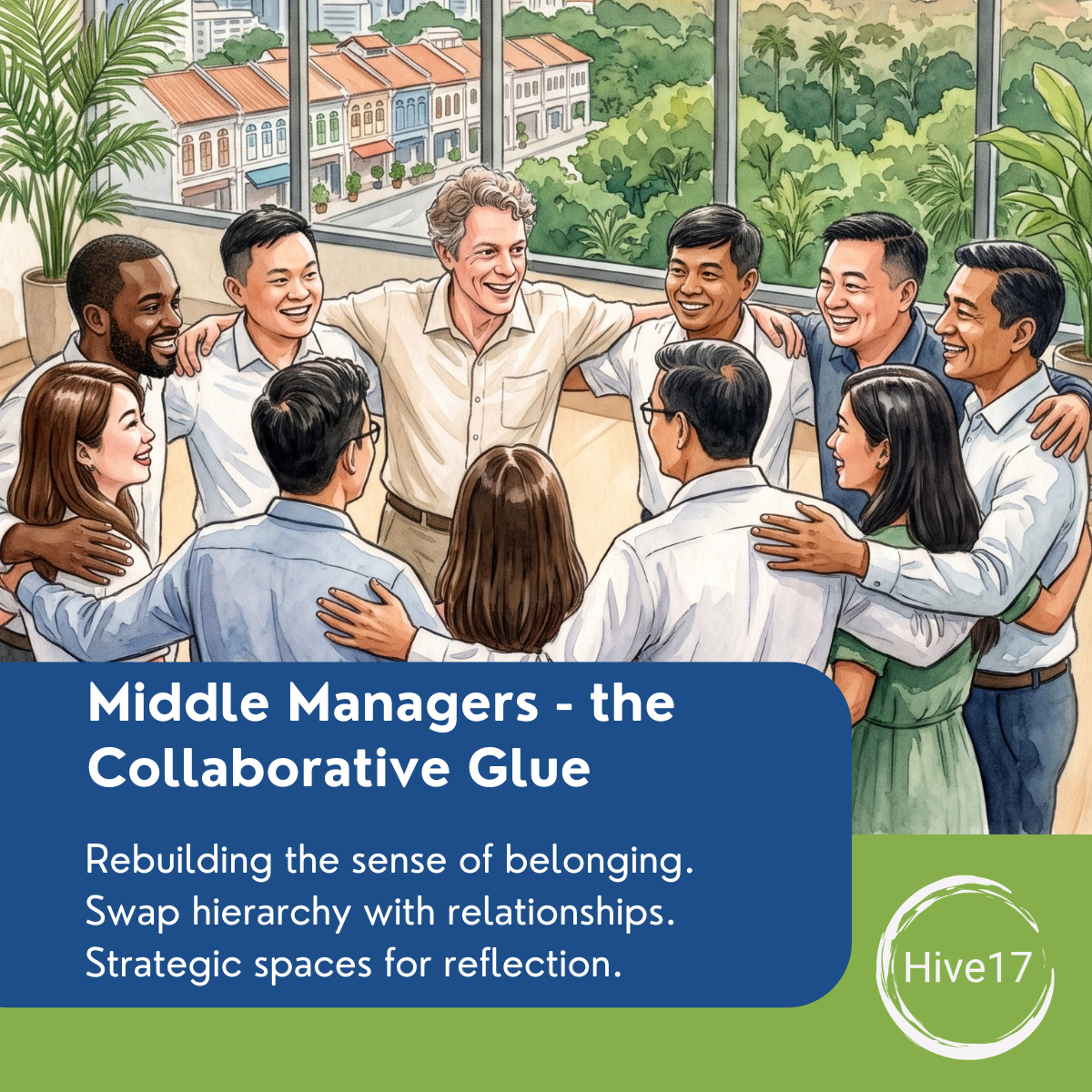
Rebuilding the Sense of Belonging to Drive Productivity
Workplace isolation and low ownership directly paralyse innovation while accelerating costly talent attrition. Middle managers possess the unique proximity required to cultivate deep belonging, transforming fragmented teams into accountable, high-performing units.Shifting from Top-Down Control to Relational Enablement
Traditional hierarchy stifles agility. Modern leadership demands a shift away from rigid oversight toward orchestrating trust, ideas, and energy. Middle leaders create the dynamic flow necessary for seamless cross-silo, cross-generational, and cross-cultural collaboration.Creating Strategic Spaces for Reflection and Transparency
High-speed execution without reflection leads to systemic burnout and toxic friction. Effective middle managers establish psychological safety, enabling teams to disagree productively, share transparent feedback, and slow down to speed up execution with clarity. This will keep learning at its core.
Collaborative intelligence is converted into tangible ROI. True leadership maturity transforms psychological safety into measurable performance. When middle managers bridge strategic vision with daily execution, organisations experience enhanced retention, swift decision-making, and superior customer value delivery.
Unlocking this level of maturity requires more than transactional training or generic workshops. It demands intentional capability building, structured reflection loops, and continuous coaching tailored to real-world operational challenges. At Hive17, we specialise in driving leadership transformation from within. Through our battle-tested leadership frameworks, gamified team simulations, and structured alignment programmes, we partner with executive boards and HR leaders to build resilient, human-centred organisations that consistently deliver extraordinary business outcomes.
How effective is collaboration in your management teams? Our Pulse™ Team Effectiveness Assessment can give you a snapshot of your current maturity in collaboration, team effectiveness, and team dynamics.
Source: Future of Middle Management, Future Work Forum, 2026 (link)
